You have switched to winter tires, driven home, and noticed that the vehicle feels a little different. What should you check during the first week, and what should send you back for help? Start with the installation instructions, cold inflation pressures and any new symptoms. Keep the prescribed wheel-fastener recheck on your calendar, learn the new set's normal sound without testing its limits, and take a persistent shake, pressure loss or obvious damage seriously. A seasonal changeover is the beginning of winter tire care, not the end of it.
This guide is for a Calgary driver whose winter set is already installed. It separates useful observations from guesses, with examples for a short city commute, a longer ring-road drive and a household sharing one vehicle. It is not a substitute for the instructions for your particular car, wheels and tires. Those instructions control pressure, fitment, fastener torque and any required follow-up. The aim is to leave you with a small, usable record instead of a week of wondering whether something is normal.
Before leaving: get the three instructions that matter
The most useful handover has three parts: the cold pressure specification, the wheel-fastener follow-up and the instructions for anything you should watch. Ask where the pressure figure came from. For an original approved fitment, the vehicle tire-information placard and owner's manual are the starting points. If the winter wheels use an approved alternative size, have the applicable pressure requirements confirmed rather than copying the summer set's number from memory.
Next, establish the follow-up distance or timing for checking the wheel fasteners. Write down the actual instruction you received, together with the odometer reading at installation. Do not substitute a number from a friend's pickup, a social-media comment or an article written for another wheel system. Continental's general guidance discusses a check after approximately 50 kilometres; that illustrates why a follow-up matters, but the applicable vehicle and wheel instructions must govern your own set.
Finally, clarify any unfinished item. A pressure-monitor warning that requires attention should not vanish into a vague comment about winter wheels. A tire noted for wear needs a clear explanation of its condition, not an assumption that installation means it has a full season remaining. Keep the receipt somewhere you can find it without searching through the glove compartment beside a busy road. Our seasonal tire change information provides context for the work; your handover supplies the vehicle-specific details.
A useful question is, “What should I do next, and what would make that next step urgent?” That encourages a practical answer. It also separates scheduled maintenance from a symptom that should not wait for a reminder. You should leave knowing what was fitted, what was checked and what remains your responsibility as the driver.
Make a baseline while everything is easy to identify
A baseline is simply a record of what is on the vehicle now. Photograph the tire placard, the winter tire size and the service paperwork. Note whether the tires are new or returning for another season, whether the wheels are the usual winter wheels, and whether any tire was replaced individually. This is not a photographic safety inspection. It is a way to avoid supplying incomplete information if a question comes up later.
Record all four wheel positions explicitly: left front, right front, left rear and right rear. “Driver's side” is understandable in conversation, but the four-position layout is easier to share consistently. If you take pressure readings, use the same order every time. Include the unit on every line. A number without PSI or kPa invites confusion, especially when a digital gauge can change units with one button.
Use the sidewall information guide to help locate size and service-description markings. Do not assume two tires match just because the large brand lettering does. The model, size, load index and speed rating are separate pieces of information. Transport Canada recommends compatible winter tires on all four wheels and warns against mixing constructions and tread patterns that reduce stability. Factory-approved staggered fitments still need their correct position-specific sizes; a general matching rule is not permission to undo a manufacturer's design.
The load-index explanation can help you understand one of those markings, but a load index alone does not approve a replacement tire for your vehicle. Keep the complete specification. A photograph that includes the full marking is more valuable than a message saying, “They're the same size as before.” This record also helps another household driver recognize which set is currently installed.
The first cold pressure check is a measurement, not a ritual
Check inflation when the tires are cold, using the cold-check conditions in your owner's manual. A reading taken immediately after driving across Calgary is not equivalent to one taken before the day's driving. Tires warm during use, and the pressure normally rises with that warming. Do not release air from a warm tire simply to bring it down to the cold placard figure. Arrange a proper cold measurement instead.
Continental recommends regular gauge checks even on vehicles with pressure monitoring. Its guidance distinguishes the vehicle manufacturer's recommended inflation from the maximum marking on the tire sidewall. That distinction is essential: the sidewall maximum is not the everyday pressure target for every vehicle that can wear that tire. Likewise, the fact that a tire is sold for winter use does not create one universal winter pressure.
Read the front and rear specifications separately. Some vehicles use different pressures by axle or provide different instructions for particular loads. Do not make every tire equal because an even row of numbers looks tidy. A pressure adjustment must follow the actual vehicle and fitment requirements, not a preference for symmetry. Our tire-care overview is a useful place to keep general maintenance information alongside that vehicle-specific reference.
For the first check, write down the readings before adjusting anything, then the final readings. If something is unexpectedly low, that original value is useful evidence. A simple record might say “cold, before driving, outdoors, left rear lower than the other three.” You do not need a weather station or a spreadsheet. You do need enough context to avoid comparing unlike measurements and wrongly concluding that a tire has gained or lost air.
Calgary temperature swings can hide an unfinished pressure problem
A warm garage, a frosty outdoor parking lot and a sunny afternoon are different conditions. Transport Canada specifically warns that a tire checked in a warm garage can be underinflated when it is below zero outside. The practical lesson is to account for the conditions in which the vehicle is used and follow the manufacturer's guidance, not to invent a fixed extra allowance for every cold day.
Suppose a warning appears on a cold morning, then disappears after driving. The disappearing light does not prove the cold pressure was correct. The tires may simply have warmed enough to change what the system detects. Measure at the next safe, appropriate opportunity and compare with the correct specification. If the tire is visibly low, the vehicle handles abnormally or pressure is falling rapidly, stop safely and seek help rather than continuing a routine commute.
Chinook weather also makes memory unreliable. You may remember checking “yesterday,” while yesterday's check happened after a drive in much warmer air. Record whether a check was cold and whether the vehicle had been inside. That little detail is more informative than a precise-looking number with no measurement conditions. Use winter tire guidance for Calgary for the seasonal picture, but keep pressure decisions anchored to your vehicle's specifications.
Avoid assigning every loss to weather. Similar changes across all four tires during a temperature change are different from one tire repeatedly separating from the others under comparable conditions. Neither pattern is a diagnosis by itself. The second is a clear reason to have the tire and wheel assembly assessed rather than repeatedly adding air and forgetting about it.
Keep the wheel-fastener follow-up separate from pressure care
Inflation pressure and wheel-fastener torque solve different problems. A pressure gauge cannot tell you whether a wheel is securely clamped to its hub. A torque check cannot tell you whether the tire contains the right amount of air. Treating these as two separate items prevents the common misunderstanding that a quick return visit has automatically dealt with everything on the seasonal checklist.
Continental explains that seating conditions, normal forces and contamination can affect wheel-fastener clamping. Its retorquing guidance also stresses the manufacturer's specified torque and sequence. The relevant lesson for the driver is to follow the prescribed recheck and avoid improvising. More force is not automatically safer. Overtightening can damage fasteners and other components, while insufficient clamping can allow movement.
Use an odometer reminder rather than a vague “later this week” note. If your daily travel is short, several days may pass before the specified distance. If you cross the city repeatedly for work, you may reach it much sooner. For illustration only, an installation at 80,000 kilometres and a written 50-kilometre instruction would mean a reminder at 80,050 kilometres. Replace both numbers with your actual odometer and actual instruction; this is arithmetic, not a universal interval.
Do not postpone a new wobble or alarming vibration until that reminder. A scheduled check assumes there is no intervening reason for immediate attention. Equally, do not loosen fasteners, apply lubricant or use an impact tool experimentally because an online video makes it look simple. Correct tools, specifications and procedures matter. The overview of Calgary tire service is a starting point for discussing your tire work, not a substitute for the correct installation procedure.
Listen for a pattern, without trying to provoke a symptom
Different tread designs can sound different on dry pavement. The useful question is not whether winter tires are perfectly silent. It is whether a new sound is steady or changing, tied to one surface or present everywhere, and accompanied by vibration, pressure loss or handling changes. A description of the pattern gives a tire professional something more useful than “the tires are loud.”
Notice what happens during ordinary, safe driving. Does the sound change when the road surface changes? Did it begin immediately after installation, or only after crossing a rough patch? Is there a rhythmic thump that repeats with wheel rotation? You do not need to identify the faulty component, and you should not conduct a high-speed experiment to sharpen the description. Your job is to report observations and avoid driving through a potentially serious condition.
Do not reach for the radio volume as the first fix. If a sound is new and persistent, have it assessed. A smooth hum on one coarse surface and a sudden pounding sound with a shake are not equivalent. Nor is every noise caused by the tires. KMJ Tire provides tire services and oil changes; mechanical concerns belong with an appropriate specialist. That distinction matters because a recent tire change can attract blame for a problem that needs a different kind of inspection.
Our wheel-balancing page explains one tire-service topic that can enter the conversation. Balancing is not a blanket answer to every sound or steering complaint. Ask what was found and what evidence supports the proposed next step. A useful service explanation connects the symptom to the inspection result instead of simply applying the same remedy to every vehicle.
A shake after changeover deserves a better answer than “winter tires”
Continental describes imbalance as uneven weight distribution in a tire-and-wheel assembly and identifies vibration as a possible symptom. That does not mean vibration proves imbalance. A wheel or tire condition, accumulated material, installation concern or mechanical issue can produce a complaint a driver describes in similar words. The first step is assessment, with priority based on the severity and circumstances.
If the shaking is severe, appears suddenly, or comes with unstable handling, stop in a safe place and arrange assistance. Do not keep accelerating to see whether it disappears at a different speed. If the symptom is mild but persistent, avoid unnecessary travel and obtain advice promptly. Tell the provider whether the vehicle was smooth before the changeover and whether anything happened afterward, such as an impact or driving through deep snow.
For example, a driver might report: “The first city trip was smooth; on the next ordinary highway trip I felt a steady vibration through the seat, so I returned without testing higher speeds.” That is a useful sequence. It does not prove the rear wheels caused the symptom, and the location where you feel a vibration is not a reliable substitute for inspection. It does explain when the complaint appeared and what changed.
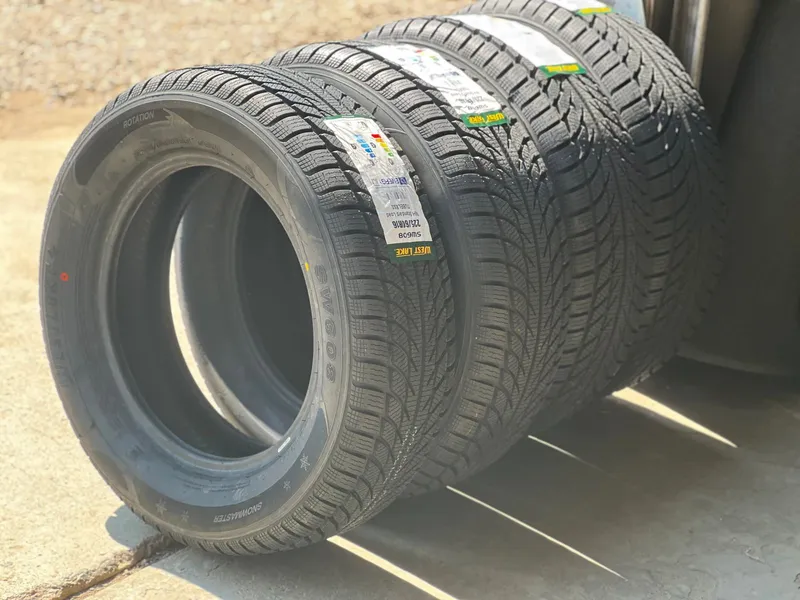
Keep service possibilities separate from promises. Standard balancing and more specialized testing are not identical, and a photograph of a wheel balancer does not establish every available machine capability. The image accompanying this article shows three loose winter tires with tread and product labels visible at KMJ, not an installed set, a test result or a completed repair. If you are comparing service options through the tire-buying guide, include follow-up questions about fitment and ride concerns, not just the tire's brand name.
Pressure monitoring helps, but the gauge still has a job
Learn the instructions for the pressure-monitoring system in your own vehicle. Systems differ in what they measure, what they display and how they respond after tire service. Do not assume a reset procedure copied from a similar-looking dashboard applies to your model. A warning can require an inflation check, a system procedure or further assessment; the owner's manual supplies the correct interpretation and sequence.
After a changeover, record the warning's exact wording or symbol once safely parked. If the display shows individual pressures, note the values and the wheel positions it identifies. Then verify actual pressures with a suitable gauge as directed. Do not assume a display that still shows yesterday's values represents a fresh measurement, and do not assume an extinguished warning makes regular checks unnecessary.
One household mistake is to erase the only evidence. A driver sees a warning, another driver resets something, and neither person records the original message or the pressures. A brief note before following the correct procedure is more useful. It also prevents the next driver from assuming that someone else already corrected the condition rather than merely silencing a reminder.
If a warning remains unresolved, describe it when arranging tire assistance. Our mobile tire-service information can help you understand that service route, while the actual vehicle, location and requested work determine suitability. Do not drive an unsafe tire to a preferred location simply because it is familiar. Where the vehicle is, how it is behaving and whether it can be moved safely come before convenience.
Watch one low tire without turning topping-up into a routine
A tire that repeatedly loses pressure needs assessment. The potential explanation may involve the tire, valve or wheel, but you cannot confirm the cause from a dashboard number alone. Record the cold readings, the timing and any visible object or damage without removing anything. Pulling out an embedded object can change the situation and accelerate air loss; leave the assessment to someone equipped to deal with it.
Our tire-repair information is useful background, but repairability depends on an actual examination and the applicable tire guidance. Do not promise yourself that a visible screw automatically means a simple repair. Location, damage and the tire's operating history matter. If it has been driven significantly underinflated or flat, say so, even if adding air makes the outside look normal again.
A better report is factual: “The other three readings were similar on two cold checks, but this one was lower again after adjustment.” Include how much driving occurred, whether sealant was used and whether the vehicle was driven while the warning was active. Avoid turning that information into a guessed diagnosis. The service provider can use it to choose the appropriate inspection.
A rapid loss, visible collapse, bulge or serious cut is not a recordkeeping project. Stop safely and get help. Assistance arrangements depend on the location and circumstances; having a provider in mind is not a guarantee of immediate availability or permission to continue on a damaged tire. If you are exposed to traffic, prioritize personal safety and appropriate roadside assistance over attempting a close inspection beside moving vehicles.
Returning winter tires need a condition check, not nostalgia
A set that felt fine last March has not automatically earned another full winter. Look at its current condition and measured tread, along with the inspection and manufacturer guidance. Transport Canada cautions against using tires worn close to 4 millimetres on snow-covered roads. That is winter-use guidance, not a promise that every tire above that depth is undamaged or suitable for every trip.
Record measured tread by position when it is available. Do not reduce four tires to one average. A deeper tire does not donate its traction to a much more worn tire elsewhere on the vehicle. If wear varies markedly, ask about the cause and the correct plan for the vehicle. Where an underlying mechanical issue is suspected, it needs the appropriate specialist rather than an unsupported assurance that changing tires fixes it.
Tread appearance can also mislead. A bold pattern may look substantial from standing height, while the remaining usable depth tells another story. Conversely, fine slits in the tread are not a measurement of the main grooves. If you cannot confidently identify where and how to measure, request a demonstrated reading. Use the same method when comparing later readings so you are not manufacturing a trend from inconsistent technique.
When replacement becomes part of the discussion, budget-versus-premium tire considerations can help frame priorities. Start with suitability and condition, then compare cost and features. A worn premium tire is not automatically preferable to a suitable new alternative, and a higher purchase price is not evidence that an old set is still fit for snow. The condition of the tires currently carrying the vehicle is the immediate issue.
Do not let one dry afternoon redefine the whole season
A clear Calgary afternoon can make a winter set feel unnecessary until the next cold commute. Plan around the conditions you will actually encounter, including the early start, shaded sections and the return trip. Transport Canada explains that all-season and summer tires begin losing elasticity below 7°C, while winter tires retain flexibility at lower temperatures. That general explanation is not a sharp switch that makes every road safe on one side of a thermometer reading.
A driver comparing all-season tires with all-weather tires should distinguish categories and the specific tire's markings and performance. A severe-snow symbol indicates meeting specific snow-traction requirements; it does not erase the differences between products or guarantee grip on polished ice. Once your winter set is installed, the immediate task is using and maintaining it correctly, not interpreting every pleasant afternoon as a reason to change back.
Leave more room and use smooth inputs as conditions require. Do not deliberately brake hard or corner sharply on public roads to “see what the new tires can do.” The limits can change within the same trip. A vehicle that accelerates confidently can still need substantial distance to slow down on a slippery surface, and familiar roads do not provide familiar grip every day.
This is particularly relevant to an early trip onto Deerfoot or Stoney Trail after a short neighbourhood drive. The first few quiet blocks do not sample every surface ahead. Make time for the route and the weather instead of treating the new set as compensation for leaving late. Good tire preparation supports careful driving; it does not replace the driver's decisions.
A short-commute example: make distance visible
Imagine a household whose weekday driving is mostly school drop-offs and errands, totalling roughly eight kilometres a day. These are hypothetical numbers, not a recommended driving plan. The winter wheels were installed on Saturday, and the written instructions include a distance-based fastener check. By the next Wednesday the calendar may feel as though a long time has passed, while the odometer tells a different story.
The useful response is not to take an unnecessary highway trip to satisfy a number. Write down the installation reading, track normal use and follow the stated instruction. If the timing or distance is unclear, ask the installer to clarify. A short-trip driver should also avoid assuming that low mileage eliminates the need for regular cold pressure checks. Temperature changes and time do not stop affecting tires because the weekly distance is modest.
Choose one accessible cold-check opportunity. A crowded school departure is usually a poor moment to discover that the gauge has gone missing. Keep it where you can find it, learn its units beforehand and leave enough time to respond if a reading is wrong. Checking just before an unavoidable deadline can tempt a driver to ignore the very result the check was meant to discover.
For a household considering how to arrange follow-up, service-area information helps with location planning. Confirm the actual service arrangement and safe work setting rather than assuming every parking location is suitable. A level private space and a busy pickup lane are not interchangeable. The practical goal is to make the required check easy enough that it actually happens.
A longer-commute example: the reminder can arrive quickly
Now consider a driver covering about 60 kilometres in a normal workday. Again, this is an illustration, not a target. A distance-based follow-up may become due much sooner than that driver expects. “I'll deal with it on the weekend” can be a poor plan if the relevant distance is reached during the first day of ordinary travel.
Record the due reading before returning to a full routine. If a prescribed check would fall during a work trip, discuss the timing in advance. This is a scheduling issue you can solve before it becomes a rushed decision. It is not a reason to choose a different torque value, defer a symptom or rely on the fact that the vehicle still feels smooth.
For someone heading west on Highway 1, add a cold pressure and condition check before the longer journey, as Transport Canada recommends for highway driving and longer trips. Review current road and weather information separately. This article does not establish today's road conditions, and a tire service record cannot tell you what the mountain route will look like when you arrive.
Carry the service details in a form you can access while parked. If a concern appears away from home, the exact fitment, recent work and timeline are useful to a local professional. Our tire selection pages can help identify product information, but an internet listing is not a record of what is installed on your car. Keep the actual tire markings and receipt together.
Work vehicles need a handover between drivers
A shared work vehicle can lose its tire history in a single shift change. The person who collected it after service may know about a follow-up instruction, while the next driver knows only that the winter tires are on. Put the essentials in the vehicle log: installation date and odometer, required next check, any unresolved warning and the person responsible for following through.
Load requirements deserve the same clarity. Use the vehicle manufacturer's instructions for the actual operating configuration. Do not copy an unloaded passenger-car pressure routine onto a van or work truck carrying tools and materials. Tire load ratings, axle limits and vehicle limits are separate constraints, and adding air cannot authorize a vehicle to exceed its load limits. If the correct pressure for the approved fitment and use is uncertain, resolve it before the vehicle returns to duty.
The commercial tire-service overview and fleet-management information provide starting points for organizing tire work. They do not replace the operating specifications for each vehicle. A fleet checklist should identify the vehicle, not merely say that all units get the same pressure or follow-up interval.
Assign responsibility for the response as well as the check. If a driver records a low tire and no one is tasked with dealing with it, the log becomes a history of ignored warnings. A useful process says who receives the report, whether the vehicle is held out of service and who confirms it is ready to return. Even a two-vehicle business benefits from that simple chain of responsibility.
Snow, grit and wheel appearance: look without dismantling
The first week can include dry pavement, slush and a layer of road grime. Take a look at the tires and wheels while the vehicle is safely parked. You are looking for a visible change such as obvious damage, a tire that appears low or material packed around a wheel. This is an observation, not a substitute for checking pressure or having a concerning assembly inspected.
Do not crawl under an unsupported vehicle or chip aggressively around components to investigate a vibration. If packed material is present, explain that when seeking advice. If the symptom remains after an appropriate safe cleaning, the observation does not establish that the original cause was harmless. Avoid guessing from a single visual clue. The tire-and-wheel assembly needs to be considered as a whole.
Calgary road salt and grit make it harder to see details, so use decent light and avoid turning a roadside stop into a cleaning session. A quick visual check in a safe parking space is different from working beside a traffic lane. If you discover a cut, bulge or obvious deformation, do not use cosmetic cleaning as a reason to delay assessment. Appearance alone cannot establish the internal condition of a tire.
Likewise, the absence of a visible balance weight on the outer face does not prove a wheel was not balanced. Weight placement can vary with the wheel and balancing method. Do not remove or relocate weights because they look untidy. The correct conversation is about the work performed and the symptom observed, not a home redesign of the assembly based on what is visible from the curb.
Questions worth asking before spending more money
A new complaint does not automatically require new tires, and a worn or damaged set does not become suitable because replacement is inconvenient. Ask what the inspection found, what can be corrected and what cannot be established without further assessment. That separates a maintenance adjustment from a fitment problem or a tire that needs replacement.
If a different tire is being considered, compare complete models and specifications rather than buying a familiar brand name alone. For example, the information on Michelin tires in Calgary is a starting point for exploring a brand, not a statement that every model in its range is a winter tire or fits your vehicle. Ask about the specific product and your actual driving conditions.
A studded option is another distinct decision, not a repair for an existing vibration or pressure loss. If you are considering it, read the tire-studding information and confirm tire compatibility, intended use and applicable route rules with current authorities. This guide does not claim that studs are required for every Calgary driver, nor that an existing tire can necessarily be studded after use.
When cost is the limiting factor, obtain the actual quote and terms. The tire-financing information can explain that avenue without implying approval, a particular rate or a guaranteed payment. The important first-week decision is whether the current set is suitable to keep using. Payment planning follows that assessment; it should not be used to talk yourself into continuing with a tire already identified as unsafe.
A symptom report that saves a second conversation
You can make a useful report in six lines. Identify the vehicle and installed tire size. State when the work happened and the odometer then. Describe the symptom in ordinary words. Record when it occurs during normal use. Add any pressure readings with their cold or warm context. Finish with impacts, warnings or other events since the changeover. Keep guesses out of the description unless you clearly label them as guesses.
Here is a fictional example: “Winter wheels fitted Saturday. A new shake started on Monday's ordinary commute, after the vehicle had initially felt smooth. I felt it through the seat and did not test higher speeds. No recent impact that I know of. The parked cold readings are written below with units. The scheduled wheel-fastener check has not yet been completed.” That report helps a professional assess urgency and decide what information is missing.
A second fictional example concerns pressure: “The right rear was lower at two comparable cold checks. I added air once to the specified value, recorded the reading and have not removed the visible object in the tread. I have not used sealant.” If you did use sealant or drive while flat, state that instead. An accurate inconvenient fact is more helpful than an incomplete tidy story.
Arrange the next step based on the advice and the vehicle's condition. The online scheduling page is available for suitable planned work, but an urgent roadside situation is not a routine calendar exercise. Make clear whether the vehicle is parked safely and whether moving it is in question. No booking confirmation can replace a judgment about whether a damaged tire should be driven.
Your end-of-week review should fit on one screen
At the end of the first week, gather what you already know instead of starting a new inspection programme from scratch. Confirm that the specified fastener follow-up was completed or is scheduled according to the actual instructions. Keep the record of the cold pressures and the source of their specifications. Resolve any warning, persistent vibration or repeat loss rather than silently carrying it into the rest of winter.
Check that everyone who drives the vehicle knows what remains outstanding. A note saying “all done” is misleading if it actually means only that the tires were installed. Use specific descriptions: changeover completed, required recheck completed, warning assessed, or further inspection pending. This is particularly helpful when someone else takes the vehicle for a longer trip after a week of short errands.
Then return to regular tire care. Continental recommends gauge checks every two to four weeks, while Transport Canada emphasizes checks before highway driving and longer trips. Follow your vehicle and tire guidance and respond sooner to symptoms or substantial changes in conditions. The first-week record is a baseline for those later checks, not permission to ignore the set until spring.
For more detailed seasonal reading, keep the KMJ tire blog alongside your owner's manual, rather than in place of it. The practical result of a good first week is not perfect confidence in every sound. It is knowing your specifications, completing the required follow-up and recognizing when something needs a professional assessment. That is a more useful winter habit than assuming a freshly installed set has already answered every question.
Primary references and the limits of this guide
Transport Canada's Using winter tires supports the guidance on four compatible winter tires, severe-snow markings, cold-weather pressure checks and tread condition for snow. Its winter-depth advice is presented here as safety guidance, not as a claim about the legal minimum in every jurisdiction.
Continental's tire-pressure guidance supports regular cold gauge checks, the distinction between vehicle recommendations and sidewall markings, and the need to check even with monitoring equipment. The wheel-retorquing explanation explains follow-up checks and manufacturer-specific torque. The balancing overview explains assembly imbalance and possible vibration symptoms. None of those general pages provides your vehicle's complete service instructions.
These sources were reviewed on November 7, 2026. The driving examples are illustrative, not customer stories or measurements from Calgary roads. No prices, product availability, completion times or specific inspection outcomes are implied. KMJ Tire's scope is tire services and oil changes; concerns outside that scope require the appropriate specialist. Use the general principles here to ask clearer questions, while using the actual vehicle, wheel and tire instructions to make the specific maintenance decisions.